NEW CUSTOMERS: 15% OFF WITH CODE SMD15 · FREE SHIPPING ON ORDERS $99+


J-36 Tailless Stealth Aircraft: A Glimpse Into the Next Generation of Fighter Aviation

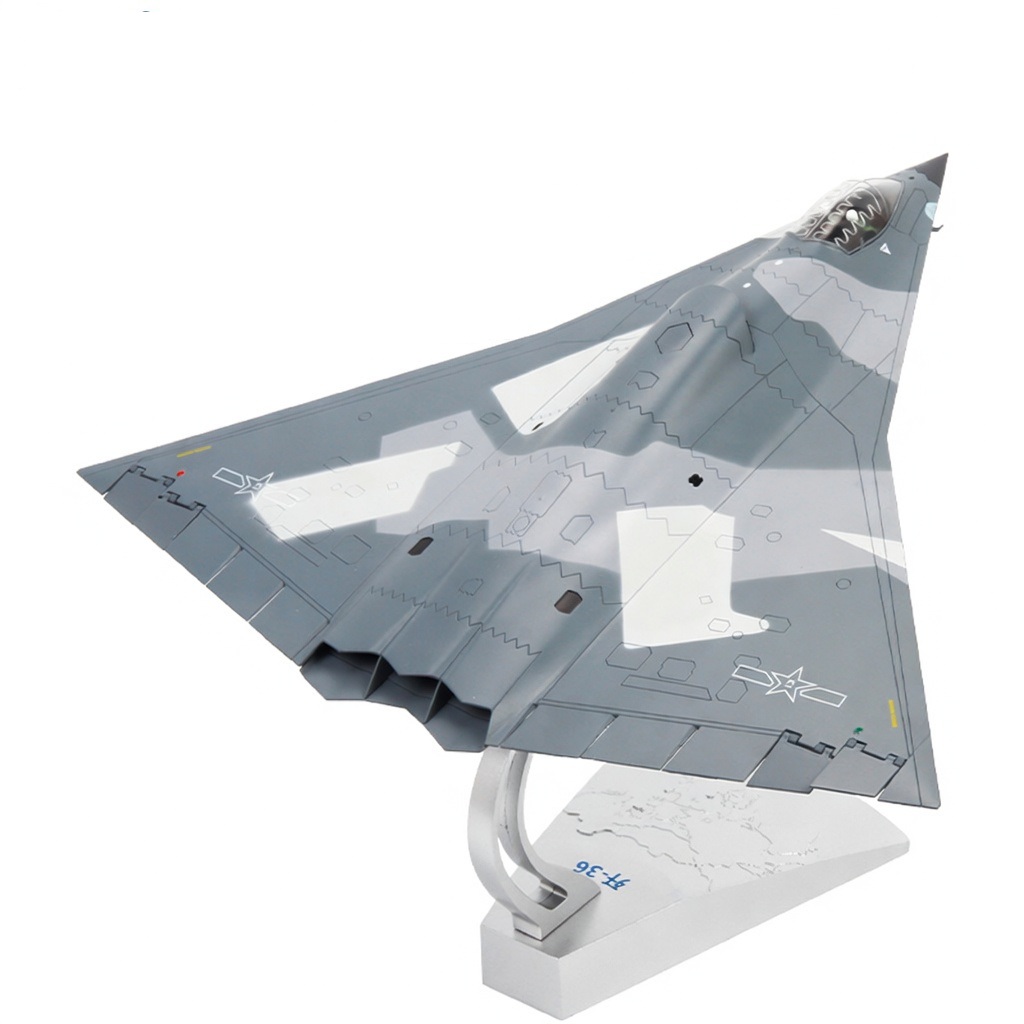
Modern military aviation is entering an era of rapid technological change, and few aircraft have attracted as much attention as the J-36. With its enormous tailless airframe, broad blended fuselage, and unconventional diamond-like planform, the aircraft looks unlike the conventional fighters that have dominated military aviation for decades.
First publicly seen in flight in late 2024, the J-36 has quickly become one of the most closely watched next-generation fighter aircraft in development. Although its official designation, operational role, and final configuration remain unclear, the aircraft is widely discussed in the context of emerging sixth-generation fighter technology and the future of stealth combat aviation.
For scale model collectors, the J-36 offers something particularly compelling: the opportunity to own a representation of an aircraft that could become an important part of the next generation of military aviation.
A New Approach to Fighter Design
The most immediately recognizable feature of the J-36 is its lack of conventional vertical tail surfaces.
Traditional fighter aircraft typically rely on vertical stabilizers and horizontal tailplanes for aerodynamic stability and control. The J-36 takes a very different approach, integrating its control surfaces into a broad, highly blended airframe.
Its distinctive shape has led aviation observers to describe it as a tailless stealth aircraft with a broad diamond-like configuration. The resulting silhouette is exceptionally wide and streamlined, giving the aircraft a futuristic appearance that looks dramatically different from current-generation fighters.
This configuration may also contribute to the aircraft’s low-observable characteristics. By eliminating prominent vertical tail surfaces and carefully blending the fuselage and wings, designers can potentially reduce radar reflections from certain aspects of the aircraft.
The precise aerodynamic and stealth characteristics of the J-36 remain unknown, however, as the aircraft is still undergoing development and flight testing.
Is the J-36 a Sixth-Generation Fighter?
One of the most interesting questions surrounding the aircraft is whether the J-36 should ultimately be considered a sixth-generation fighter.
The term “sixth-generation fighter” does not currently have one universally accepted definition. Different countries and defense organizations may emphasize different technologies when describing the next generation of combat aircraft.
Nevertheless, sixth-generation fighter programs are generally associated with concepts such as advanced stealth, long-range operation, highly integrated sensors, network-centric warfare, autonomous or optionally crewed operations, and the ability to coordinate with unmanned aircraft.
The J-36 has several characteristics that have led analysts and aviation enthusiasts to associate it with this emerging generation of aircraft.
Its large tailless configuration, extensive internal volume, stealth-oriented shaping, and apparent emphasis on long-range operations are notably different from the design philosophy of many existing fourth- and fifth-generation fighters.
For that reason, the J-36 is frequently discussed as a potential sixth-generation combat aircraft or as part of the broader development of next-generation airpower.
However, it is important to distinguish between analysis and confirmed information. The aircraft’s final role and capabilities have not been publicly established, and the term “sixth-generation fighter” should therefore be understood as a classification used in current discussion rather than a confirmed official designation.
Why the J-36 Could Define the Next Generation
The significance of the J-36 goes beyond its unusual appearance.
Publicly available imagery has revealed a large aircraft with multiple engine intakes, a highly blended airframe, and a configuration that appears designed around a combination of low observability, range, speed, and internal weapon carriage.
These characteristics have led to speculation that the aircraft could have a long-range combat role, although its exact mission remains unconfirmed.
The aircraft’s size is particularly noteworthy. Compared with conventional fighter designs, the J-36 appears optimized around a much larger airframe. This could provide additional internal space for fuel, sensors, weapons, and other mission systems.
Such characteristics are consistent with one of the broader trends associated with next-generation fighter aircraft: moving beyond the traditional concept of a lightweight air-superiority fighter toward highly connected, long-range platforms capable of operating as part of a larger combat network.
The exact capabilities of the J-36 will only become clearer as the program progresses.
The J-36 Is Still Evolving
Unlike famous aircraft such as the F-22 Raptor or F-35 Lightning II, whose designs and operational roles are well established, the J-36 remains a developing aircraft.
Publicly observed prototypes have already demonstrated changes to important external features, showing that the design is continuing to evolve.
This is particularly significant for anyone interested in sixth-generation aircraft development.
A prototype is not necessarily representative of the final production aircraft. Aerodynamic surfaces, propulsion systems, sensors, landing gear, weapons integration, and other elements can all change during flight testing and engineering development.
The J-36 therefore represents a fascinating snapshot of an aircraft program in progress.
Capturing the J-36 in 1:72 Scale
Our J-36 Tailless Stealth Aircraft Model in 1:72 scale brings this unusual next-generation aircraft into a collectible display format.
The model combines die-cast alloy and ABS plastic and measures approximately 32.5 cm in length, with a wingspan of approximately 34.5 cm and a height of around 7 cm.
At approximately 1.5 kg, the model has a substantial presence while remaining practical for display in a collection.
The most striking feature is its silhouette.
At 1:72 scale, the enormous span and unusual proportions of the J-36 remain immediately recognizable. The broad wing-body configuration, smooth stealth-oriented surfaces, and tailless layout create a distinctive display piece from almost every viewing angle.
The model also includes a dedicated display stand, allowing collectors to present the aircraft prominently without requiring assembly.
Why Collectors May Find the J-36 Especially Interesting
Some scale models represent aircraft with decades of operational history. Others capture machines that represent a particular moment in aviation development.
The J-36 belongs firmly in the second category.
As a developing next-generation fighter aircraft, the J-36 represents an interesting moment in the evolution of military aviation. Future prototypes may introduce additional changes as engineers refine the aircraft’s aerodynamic characteristics, propulsion, sensors, weapons integration, and flight-control systems.
For collectors who follow the development of sixth-generation fighters, this makes the J-36 particularly appealing.
Rather than waiting until an aircraft becomes a familiar operational platform, collectors can preserve an early representation of its development while the story is still unfolding.
Why 1:72 Scale Works So Well for the J-36
The 1:72 scale is one of the most popular scales for aircraft collectors because it offers an effective balance between physical size, detail, and display space.
For a large aircraft such as the J-36, this scale is particularly effective.
With a wingspan of approximately 34.5 cm, the model is large enough for its unusual planform and stealth-oriented geometry to remain visually impressive without requiring the space of a much larger scale.
Its broad silhouette is especially striking when viewed from above or at an angle, making it an excellent display piece for collectors interested in modern and future fighter aircraft.
A Glimpse Into the Future of Military Aviation
The J-36 remains an aircraft surrounded by questions.
Its final designation, operational mission, performance, and eventual development path have not yet been fully established. Nevertheless, its extraordinary configuration and apparent focus on stealth, range, internal volume, and advanced combat capabilities have made it one of the most intriguing next-generation combat aircraft currently being observed.
Whether the J-36 ultimately becomes classified as a sixth-generation fighter, a long-range combat aircraft, or something that does not fit neatly into today’s categories, its development is already significant.
For scale model collectors, the J-36 Tailless Stealth Aircraft Model in 1:72 scale captures this remarkable moment in aviation history.
It is a model of an aircraft that may represent where fighter design is heading—not simply where it has been.
If you are fascinated by sixth-generation fighters, next-generation stealth aircraft, future military aviation, and emerging aerospace technology, the J-36 is a particularly distinctive addition to a modern aircraft collection.
 Warships
 Armor & Vehicles
 Missiles & Strategic Weapons
 Wide-body Airliners
 Narrow-body Airliners
 Regional & Business Jets
 Space Stations
 Manned Spacecraft
 Rockets & Launch Vehicles
 Satellites & Space Probes